1916 - Cumann na mBan

Organisation at a glance

Cumann na mBan was founded on 2 April 1914 in Dublin to organise women in support of the Irish Volunteers. Branches were established across Ireland under a Provisional Committee, with the first branch, Ard Chraobh, meeting on Brunswick Street. Its constitution endorsed the use of force if necessary, aiming to advance Irish liberty, organise women for this cause, assist in arming Irish men, and raise funds through “The Defence of Ireland Fund.” Members, drawn from professional, white-collar, and working-class backgrounds, were expected to contribute to this fund.

On the eve of the Easter Rising, Cumann na mBan was formally incorporated into the rebel “Army of the Irish Republic” alongside the Irish Volunteers and the Irish Citizen Army, under leaders such as Patrick Pearse and James Connolly. During the Rising, its members took on a wide range of roles: many served as nurses, couriers, and suppliers, while others gathered intelligence, carried dispatches, and transported arms across Dublin. Women were present in most major rebel strongholds, including the General Post Office, and some, particularly those also in the Citizen Army, such as Constance Markievicz, actively took part in combat. They also helped manage evacuations and destroy sensitive documents during the surrender, with Elizabeth O'Farrell playing a key role in delivering the surrender order. After the Rising, over 70 women were arrested, though most were released within weeks.

The files

Of the 163 files contained in this sub-series, 3 files offer the best information about the organisation’s activities during Easter Rising week. These are the files for Dublin City District Council, South Wexford Brigade and the General Headquarters file.


Dublin City District Council - CMB126 

The file documents Cumann na mBan membership in Dublin City, organised by battalion, areas and branches. It records membership strength: 669 (July 1921) and 508 (July 1922), excluding Dundrum and Rathfarnham branches. It includes branch lists, member names, and participation in the 1916 Easter Rising. Additional materials include Lily Brennan’s 1935 statement on the organisation’s founding (1914) and a notebook by “Loo” Kennedy listing Central Branch members, including those involved in the Rising.
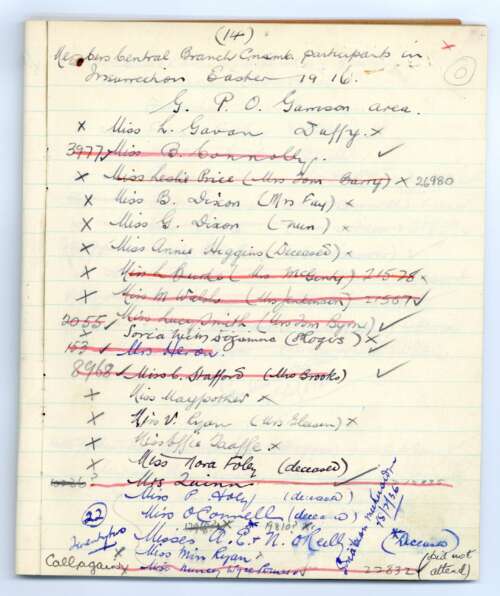
Central Branch Cumman na mBan - Margaret 'Loo' Kennedy Booklet (CMB126)

South Wexford Brigade – CMB131

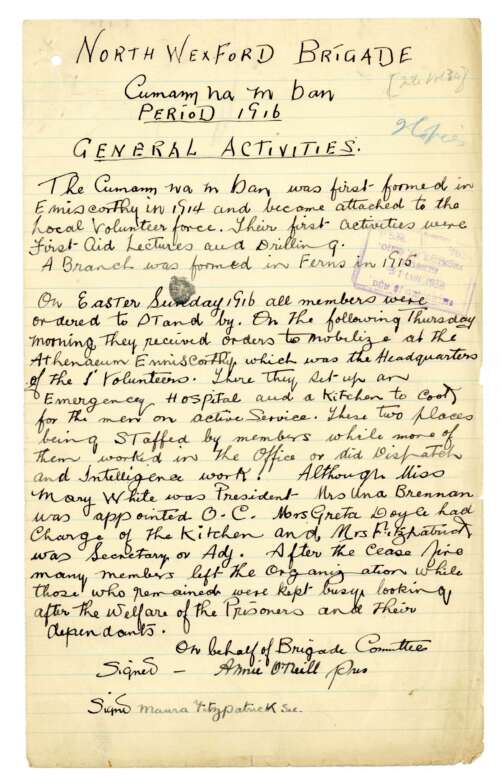
The file relates to the South Wexford Brigade, mainly consisting of correspondence about brigade records, forming a brigade committee, and compiling information for pension claims.

  • It includes typed and handwritten membership lists of Cumann na mBan, including those active around Easter 1916.
  • It contains details of brigade activities, along with names and addresses of committee officers and members.
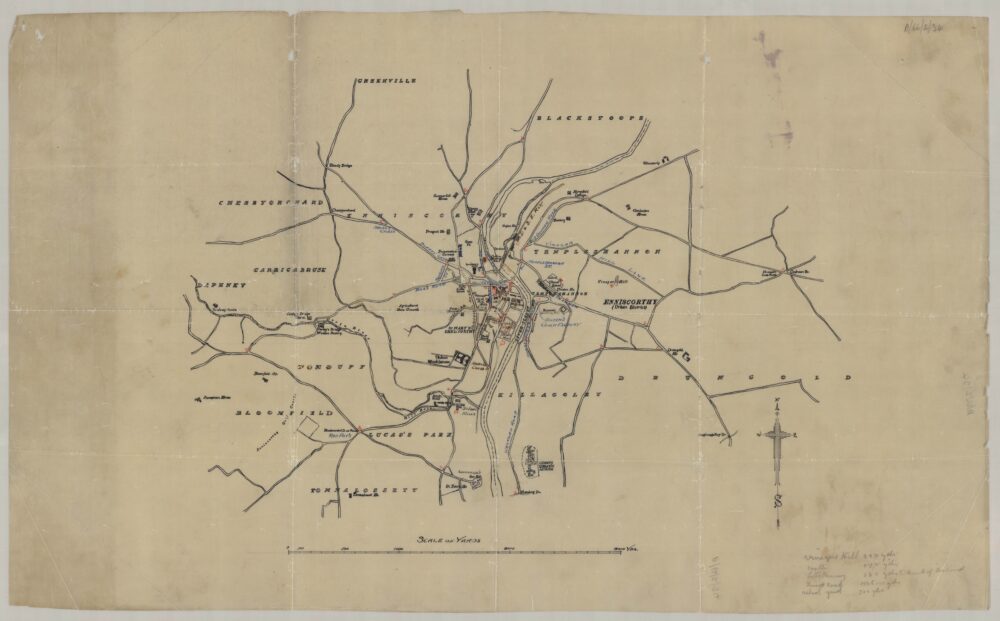
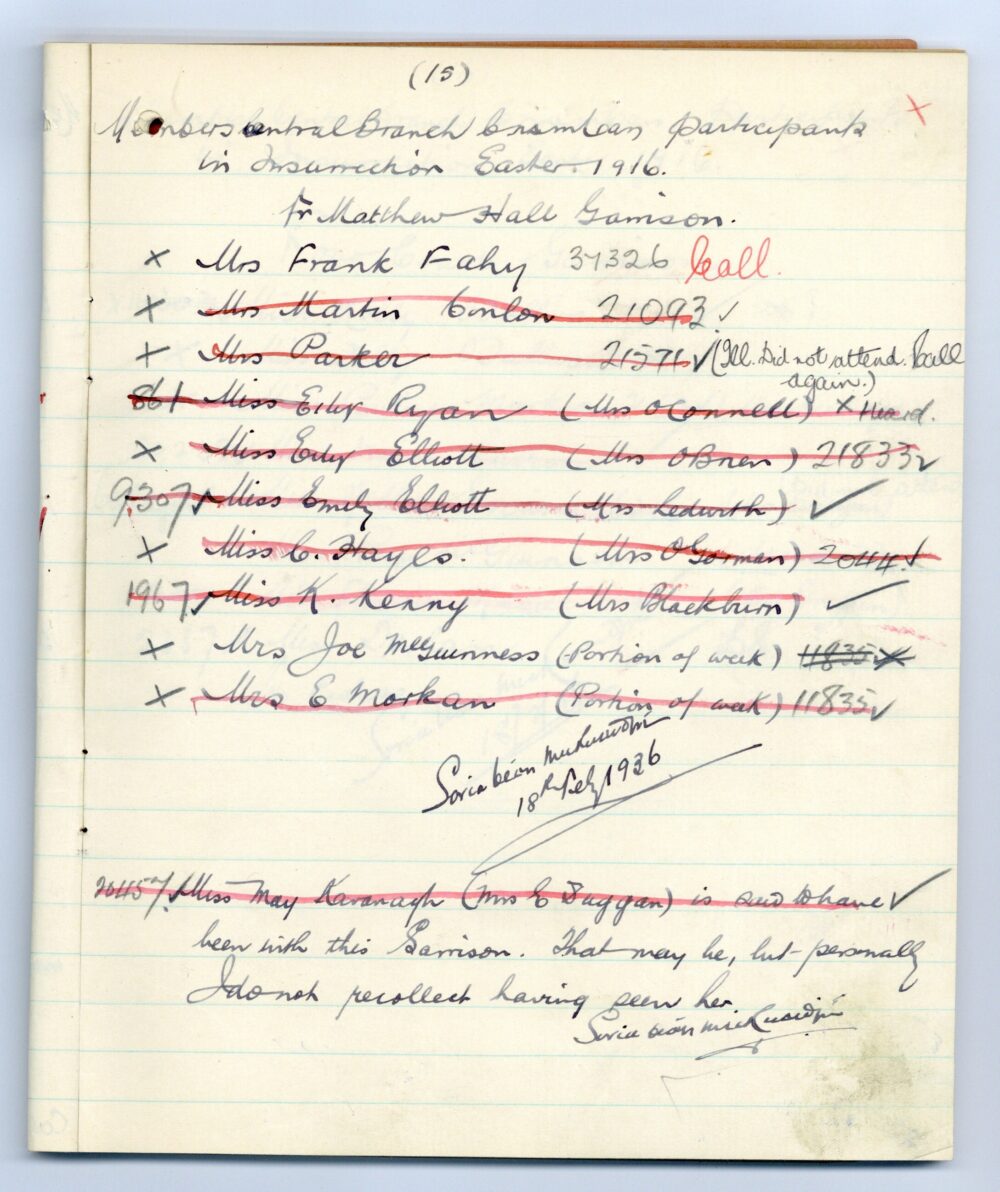
  • Also included is a typed statement by Mr Sinnott and Mr Doyle describing Cumann na mBan activities in Enniscorthy during Easter Week.
North Wexford Brigade 1916 (CMB131)

General Headquarters - CMB163 

The file relates to Cumann na mBan Headquarters, including governance records and executive membership (1920–1921) listing presidents, vice-presidents, committee members, and provincial representatives. It also contains correspondence between Margaret (Loo) Kennedy, the Association of Old Cumann na mBan, and the Military Service Pensions Board regarding submission of records for pension claims.

While the file is not primarily focused on the events of 1916, it provides valuable insight into the organisation’s formation, constitution, structure, and activities, including its role during the Easter Rising, as well as its reporting relationship with the IRA and the executive split prior to the Civil War.

The material is particularly important for understanding how Cumann na mBan service was defined and assessed. Memoranda and documents outline the criteria for qualifying service under the 1934 Act, highlighting activities such as dispatch carrying, intelligence work, medical aid, and the handling of arms and documents. A detailed transcript of Margaret (Loo) Kennedy’s 1936 deputation further clarifies organisational roles, responsibilities, and the grading of service for pension purposes.

It is also important to note that Cumann na mBan members were only able to apply for service pensions following the Military Service Pensions Act of 1934. As a result, their 1916 activities were formally evaluated roughly a decade after earlier claims had been made under the 1924 Act.

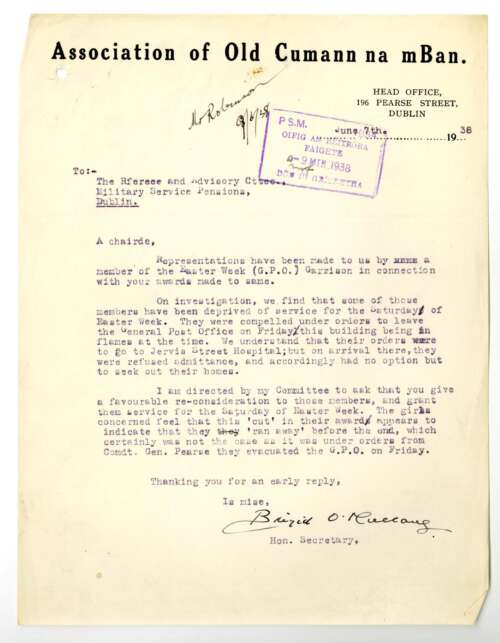
For instance, the 1916 service of some Cumann na mBan members was shortened as they were ordered to leave the GPO and then Jervis Street Hospital on the Friday.


Images below: 

“The girls concerned feel that this ‘cut’ in their awards appears to indicate that they they ‘ran away’ before the end, which certainly was not the case as it was under orders from Comdt. Gen. Pearse they evacuated the GPO on Friday”.
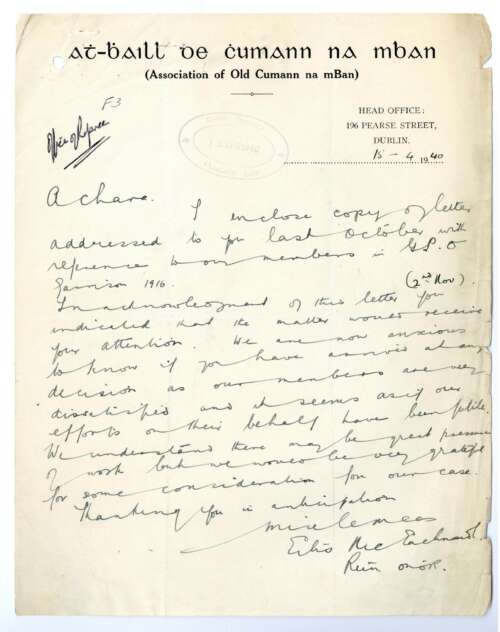
Two years later, Eilis O’Connell (Eilis Ní Conaill), Honorary Secretary of Association of Old Cumann na mBan) 34D865 LINK was still asking for a decision regarding these cases.

“The girls concerned feel that this ‘cut’ in their awards appears to indicate that they they ‘ran away’ before the end, which certainly was not the case as it was under orders from Comdt. Gen. Pearse they evacuated the GPO on Friday”.
Two years later, Eilis O’Connell (Eilis Ní Conaill), Honorary Secretary of Association of Old Cumann na mBan) 34D865 LINK was still asking for a decision regarding these cases.

Beyond 1916, the file contains a key document for understanding how “active service” was defined for women involved in the Irish Revolution. In 1939, John McCoy—a former IRA officer and later a member of the Advisory Committee—issued a four-page memorandum titled “Cumann na mBan Service.” This document set out general principles for interpreting both qualifying and active service under the 1934 Act during the War of Independence.

Subsequent material also introduces the concept of the “keyman,” a term originally applied to non-combatant male participants. This framework was later adapted and used as a basis for assessing women’s service, highlighting how existing criteria were extended to evaluate the contributions of Cumann na mBan members.