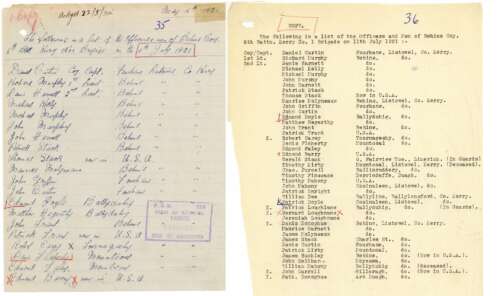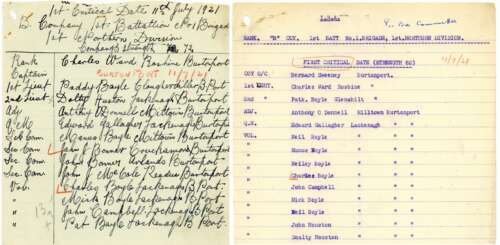
One of the most important and valuable parts of the Military Service (1916-1923) Pensions Collection (MSPC) is the IRA Nominal Roll (RO) file series. This file series provides a unique window into the structure and membership of the Irish Republican Army during the Irish Independence struggle, while also revealing how the state later assessed and recognised military service.
This article will briefly explore how and why these records were created, what they contain, and why they remain so important today.
Background to the Creation of the IRA Nominal Rolls
The IRA Nominal Rolls were an indirect result of the Military Service Pensions Act, 1934, the successor to the Military Service Pensions Act, 1924. The 1924 Act, introduced by the Cumann na nGaedheal government, aimed to recognize and reward financially those who had served in the pro-Treaty National Forces during the Civil War and who could prove active service during either or both the 1916 Easter Rising and the War of Independence.
The 1934 Act, introduced by the Fianna Fáil government, widened eligibility significantly by allowing applications from those who had taken the anti-Treaty side in the Civil War, as well as individuals with no Civil War service at all.
As a result, there was a dramatic increase in applications between the two Acts. A total of 13,355 eligible applications were processed under the 1924 Act, while 51,880 applications would be received under the 1934 Act by the initial deadline of 31 December 1935. As unsuccessful applicants could appeal against their verdicts, this meant a massive task faced by the Referee and Advisory Committee processing and adjudicating on these 1934 Act service pension claims.