Research snapshot: The IRA Nominal Rolls series in MSPC

13.05.2026

An archival exploration of the sister series of the Brigade Activity Reports.

An online presentation containing the following pointers was given on 20 January 2022, at the occasion of the launch of Mapping the IRA, part of University College Cork’s Irish Revolution Project.

Link to Recorded presentations of Public Webinar (20/01/2022).

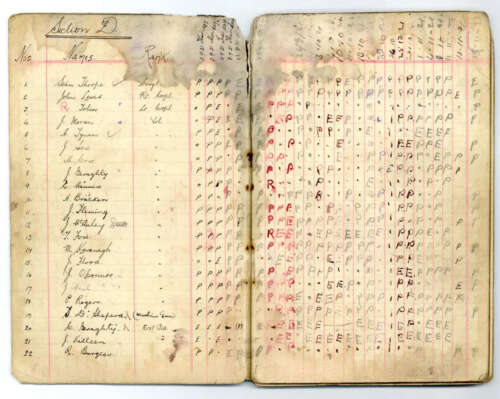
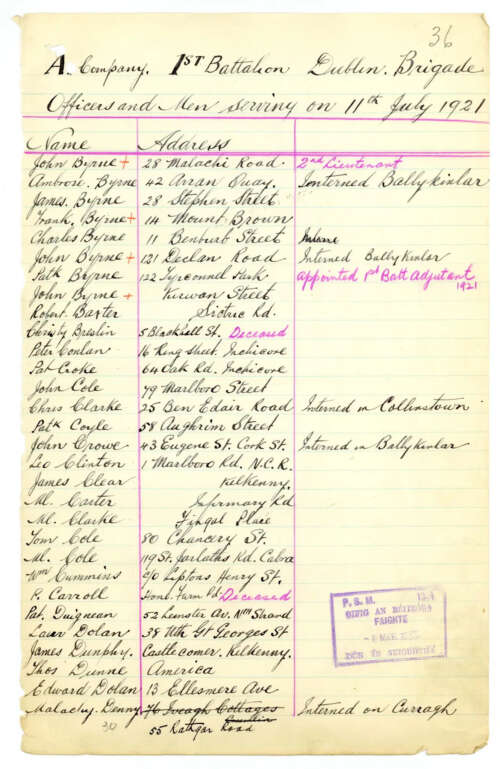
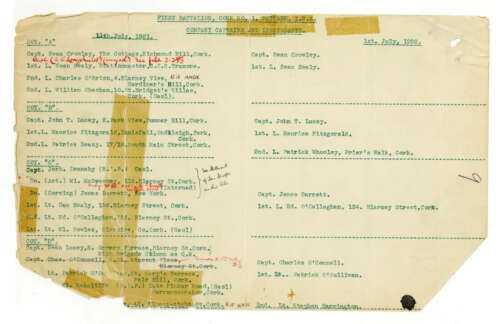
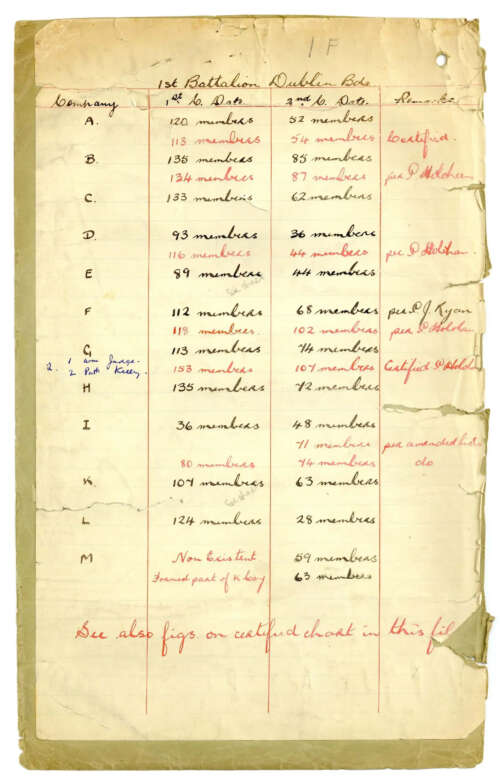
RO/2 – First Battalion, Dublin 1 Brigade

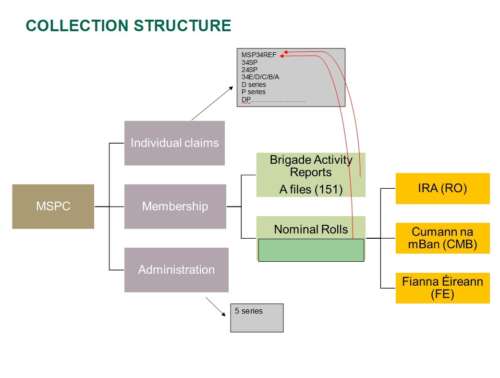
The Military Service Collection gathers around 250 to 275,000 files across 40 series divided in, roughly, 3 big groups.

  1. Membership and Organisation, with the Brigade Activity Reports and the Nominal Rolls, both sharing the same provenance in the mid-30s. Created to assist the work of the Referee and Advisory Committee verifying service claims lodged under the Military Service Pensions Act, 1934.
  2. Administration Series: 5 small series created under the Army Pensions Acts and MSP Acts (Army Pensions Board, APB Finance Officer, Service Pensions General, Military Service Pensions, 1924 and 34).
  3. Individuals (Pensions and Medals): several file series (all interconnected) created through the enactment of the Army Pensions Act from 1923 and Military Service Pensions Acts from 1924.

The IRA Nominal Rolls are themselves, a sub-series, along with the Nominal Rolls of Cumann na mBan (167 files) and Na Fianna Éireann (42 files). The IRA files are by far, the most complete with around 600 files, referenced RO1 to 611 (around 50,000 individual documents scanned).

Collection Structure

Provenance

The Nominal Rolls were, in effect, generated by the introduction of the Military Service Pensions Act, 1934, which was the successor to the Military Service Pensions Act, 1924. The 1924 Act was introduced by the Cumann na nGaedheal government and aimed to recognise and reward financially those who had served in the pro-Treaty National Forces during the Civil War and who could prove active service during the Rising and /or the War of Independence. Anti-Treaty forces and women, members of Cumann na mBan.
The MSP 1934, introduced by the Fianna Fáil government, opened the doors to all previously excluded groups. As a result the Referee and Advisory Committee found themselves overwhelmed by applications on a much greater scale than the Referee and Board of Assessors had faced under the 1924 Act. For example, while a total of 13,355 eligible applications were processed under the 1924 Act, a total of 51,880 applications would be received under the 1934 Act by the deadline of 31 December 1935.

Not surprisingly this left the Referee and Advisory Committee facing an almost impossible task in attempting to ensure that applications were dealt with in a just, appropriate and timely manner.

Apart from the above mentioned qualifying criteria the 1934 Act, both legislatively and administratively, would generally follow the example of its 1924 predecessor quite closely. We know, for example, that the officials working the 1934 Act requested and got access to the papers created under the 1924 Act for use as guidance and precedent. While the Referee and Board of Assessors, who oversaw the 1924 Act, had relied on occasion on sources it deemed trustworthy to provide information regarding activities and individuals in particular geographical or military service areas, it did not do so on a formal or systematic basis.

The Referee and Advisory Committee were already working closely with former senior IRA figures throughout the country, whether in their capacity as witnesses and references or as representatives for the applicants from their areas. Care had been taken to ensure that at least two of the members of the Advisory Committee were always former senior IRA officers – initially Murphy and John McCoy. This no doubt greatly assisted both the workings of the Advisory Committee and the establishment of links with former senior IRA figures throughout the country.

However what was now envisaged went much further.

Brigade Committees and Challenges

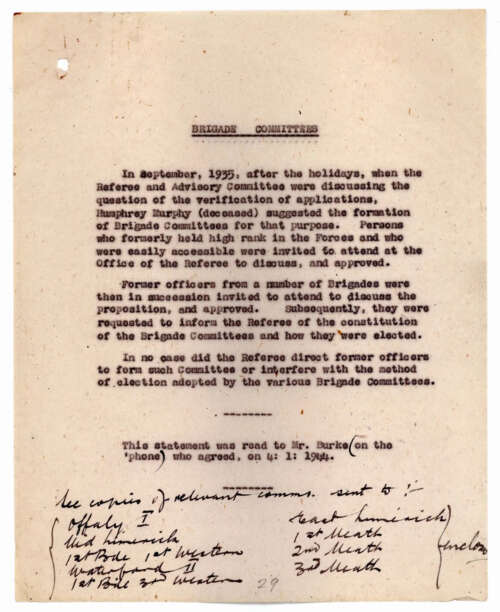
The idea of formal Brigade Committees to help process claims lodged under MSP Act 1934, is credited to Humphrey Murphy, former OC Kerry 2 Brigade and member of Advisory Committee. (to know more about the referees and membership of Boards and Committees, see Verifying Applications)

1934/ADMIN/5
1934/ADMIN/5

It would also, in theory at least, greatly assist the workings of the Referee and Advisory Committee by providing them with exactly the kind of accurate information they would need to fairly and speedily judge the overwhelmingly number of applications they were facing. Furthermore as the information was being provided by the former local officers, it would also hopefully reduce the grounds for and the number of potential complaints from disgruntled claimants.

The aim was therefore that the Brigade Committees would be a reputable and reliable resource. Not only was it envisaged that they would provide the Referee and Advisory Committee with listings of operations and activities undertaken by the Irish Volunteers and IRA, but also, with regard to major operations during 1920 and 1921, they would ultimately be asked to provide details regarding the name and nature of the operation, numbers and casualty figures for both the IRA and British forces involved, the names and addresses of the IRA participants and maps illustrating the operations (Brigade Activity Reports series).

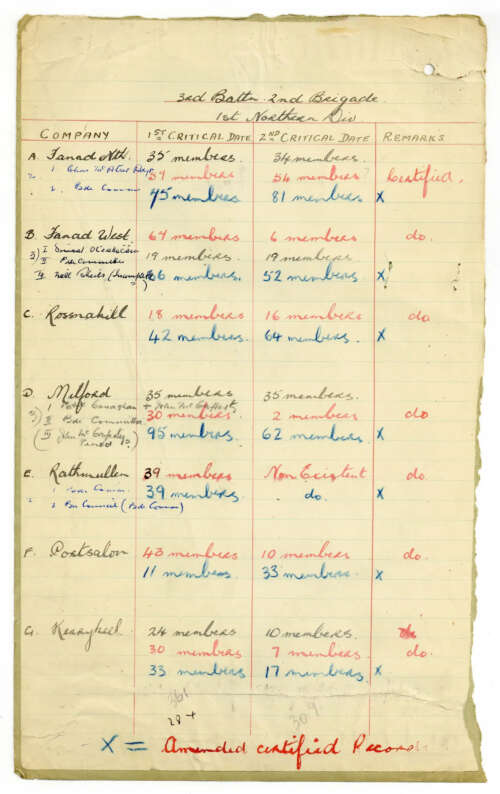
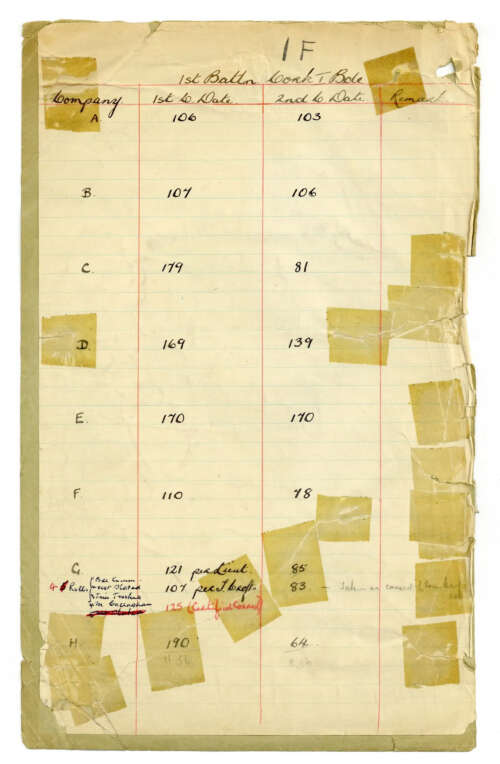
The committees would further provide detailed listings of IRA membership, down to local company level, for the two critical dates (for pension purposes) of 11 July 1921 and 1 July 1922: these files would be later known as the Nominal Rolls. Furthermore it was planned that the Brigade Committees would also actively assist the Referee and Advisory Committee by providing listings of the most active or financially deserving cases in their respective areas for priority examination, as well as giving evidence in person as verifying officers regarding applicants from their area.

Recognising the necessity that the reliability and standing of the committees should be, as far as possible, above reproach, the Referee and his office was very clear about how the committees should be constituted and the manner in which they should be set up. The Referee directed that committees should where possible be “…composed … of the [former] Brigade Staffs…” Where that was not possible the committees were to be formed following a meeting “…to which all available members of the former Brigade Staff and Battalion Commanding (or next senior) Officers would be invited ….
To further encourage the formation and efficient working of the brigade committees the Referee applied a “General Rule” that the adjudication of applications from a particular Brigade area would be delayed until the records of the particular Brigade had been completed to the Referee’s satisfaction.

R0/2_2
R0/2_2
R0/28
R0/28

Archival history and treatment

As regards the physical location of the files they were held by the Office of the Referee, which was located firstly at Griffith Barracks on the South Circular Road, Dublin and later at Coláiste Caoimhín in Glasnevin, Dublin. Following the winding up of the Referee and Advisory Committee in 1958, the files passed to Finance Branch of the Department of Defence also located at Coláiste Caoimhín. They remained there until moving to Renmore, Galway following the decentralization of Finance Branch to that location in 1989. Then with the setting up of the MSPP they were transferred to the Project office in Cathal Brugha Barracks, Rathmines, Dublin in July 2008 where they remain to this date. The series was physically in poor start when it was transferred to the Archives. It was first conserved so it coud be handled and further deterioration, stopped. It was then microfilmed to capture the information quickly and described to provide access (this was before the formal set up of the digitisation programme). As the project developed the files were entirely scanned in full colour and linked to the database. There has been no accrual since acquisition.

Series and file structure

The series’ structure is highly hierarchical structure and files are organised following IRA formation: Division, Brigade, Battalion. In Battalion files are listed the companies forming each battalion. Staff listings can be found at all levels and level of details vary.
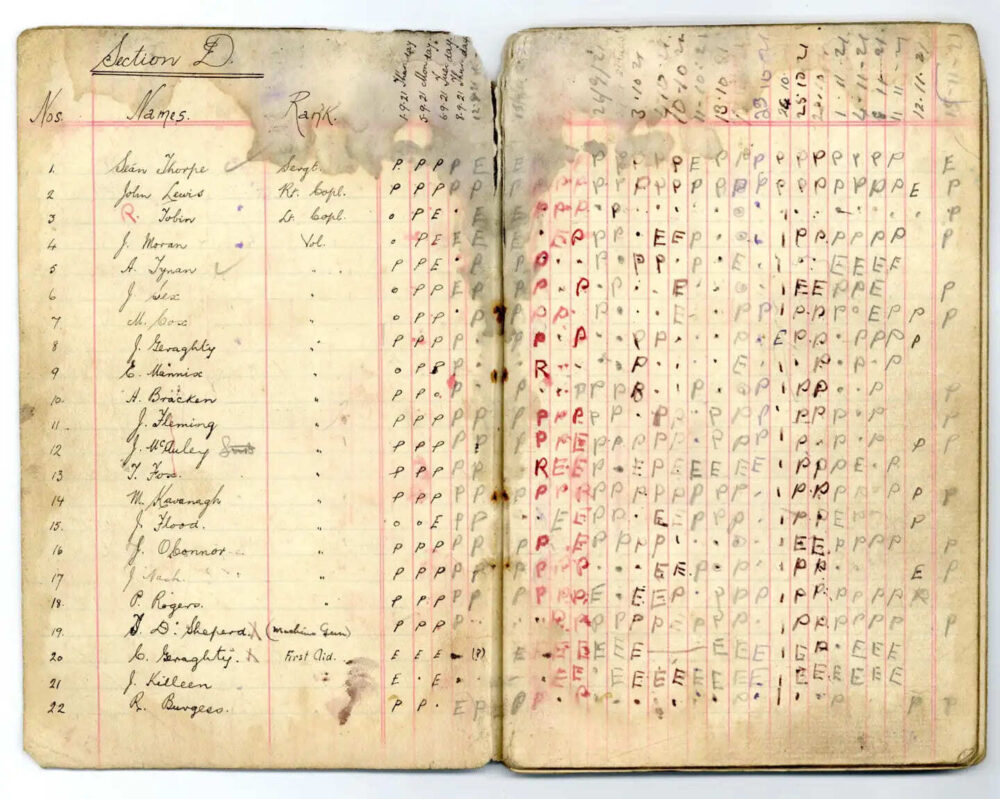
More often than not, the battalion files contain a list of strength figures broken down in the various companies, glued on the reverse of the cover. The staff names and particulars along the various rank-and-file listings form the main of the material within.
This structure is replicated in the cataloguing for which one entry describes the details of a whole Brigade.

RO/2
RO/2
RO/28
RO/28
RO/368
RO/368
RO/603A Scottish Brigade – Newspaper Cuttings